Phinite Team · March 2026 · 8 min read
MCP vs A2A: What Each Protocol Does and Why Your Platform Needs to Understand Both

MCP (Model Context Protocol) and A2A (Agent-to-Agent) have become two of the most actively discussed topics in AI infrastructure in 2025 and 2026, and also two of the most frequently confused. They solve different problems, operate at different layers of the agent stack, and are not interchangeable — yet many developers treat them as alternatives or conflate them in the same breath. This article explains what each protocol does, when each applies, and why a platform designed for real enterprise multi-agent deployments needs to understand both.
Two Protocols, Two Different Problems
The confusion between MCP and A2A usually starts in the same place: both protocols describe how AI agents communicate, and in a general sense, both are part of the emerging standards layer for agentic systems. But they operate at different levels and address different coordination problems.
MCP is a protocol for how an agent or model accesses external tools and resources. A2A is a protocol for how agents communicate with each other. The distinction is architectural. MCP describes the vertical relationship — between an agent and the tools, APIs, or data sources it needs to do its work. A2A describes the horizontal relationship — between agents that are collaborating on a shared task or exchanging state. Using them is not a choice between two options. A well-designed multi-agent system will use both: MCP to give each agent access to the tools it needs, and A2A to coordinate between agents when tasks require collaboration.
What Is MCP (Model Context Protocol)?
MCP was developed by Anthropic and released as an open standard in late 2024. Its purpose is to standardize how AI models and agents connect to external tools, data sources, and services. Before MCP, every tool integration required custom implementation — developers building a LangChain agent needed different integration code than developers building an AutoGen agent, even if they were connecting to the same underlying tool.
The problem MCP solves. Each AI model or agent framework had its own way of describing what tools were available, how to call them, and how to handle responses. This created an ecosystem of incompatible integrations: tools built for one framework did not work with another, and developers building multi-framework systems had to maintain multiple integration layers for the same underlying capability. The engineering overhead was proportional to the number of frameworks multiplied by the number of tools — which becomes unsustainable quickly.
What MCP standardizes. MCP defines a common protocol for tool description, invocation, and response handling. A tool that implements MCP can be called by any agent or model that also implements MCP, regardless of framework. This creates a genuine tool ecosystem where tools are written once and work everywhere. The standardization covers how tools describe their capabilities, how agents invoke them, how authentication is handled, and how responses and errors are formatted.
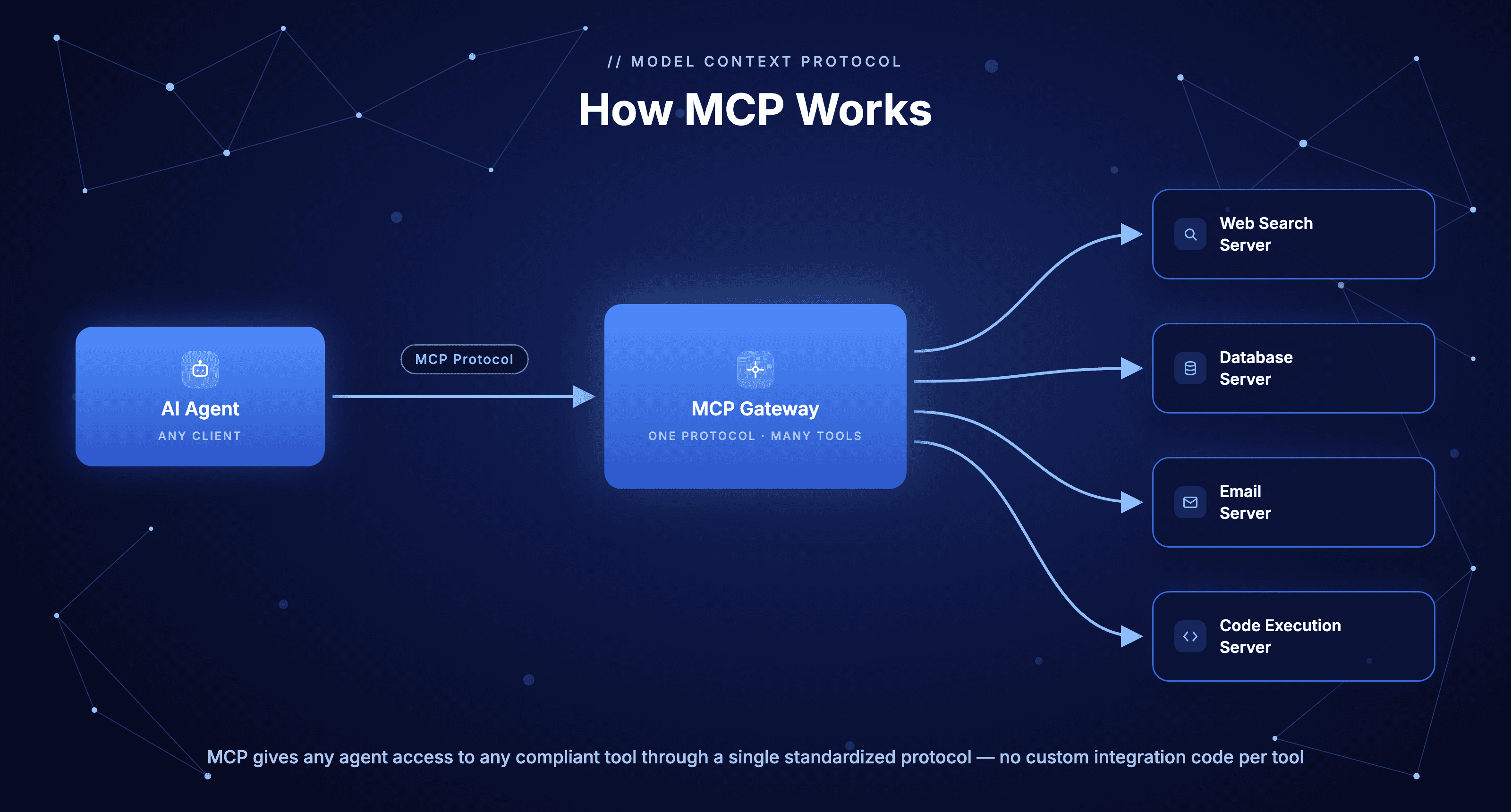
MCP in practice. An agent using MCP connects to a set of MCP servers — each server exposing a specific capability (web search, database access, code execution, email, calendar, internal APIs). The agent calls tools through the MCP protocol, which handles the interface between the agent and each tool in a standardized way. The agent does not need to know the implementation details of each tool — only the MCP interface. New tools can be added by deploying a new MCP server, without modifying the agent itself.
What Is A2A (Agent-to-Agent Protocol)?
A2A was introduced by Google in 2025 as an open standard for agent-to-agent communication. While MCP addresses how agents access tools, A2A addresses how agents communicate with each other — specifically, how a coordinating agent delegates tasks to specialist agents and receives results back.
The problem A2A solves. In multi-agent systems, agents frequently need to delegate subtasks to other agents, exchange state, and coordinate on shared objectives. Without a shared communication standard, every multi-agent framework implements its own internal messaging system that does not interoperate with agents from other frameworks. A CrewAI orchestrator cannot naturally coordinate with an AutoGen specialist agent. A LangGraph workflow cannot delegate to a specialist built on a different runtime. Each inter-framework coordination requires custom integration work that becomes a maintenance liability.
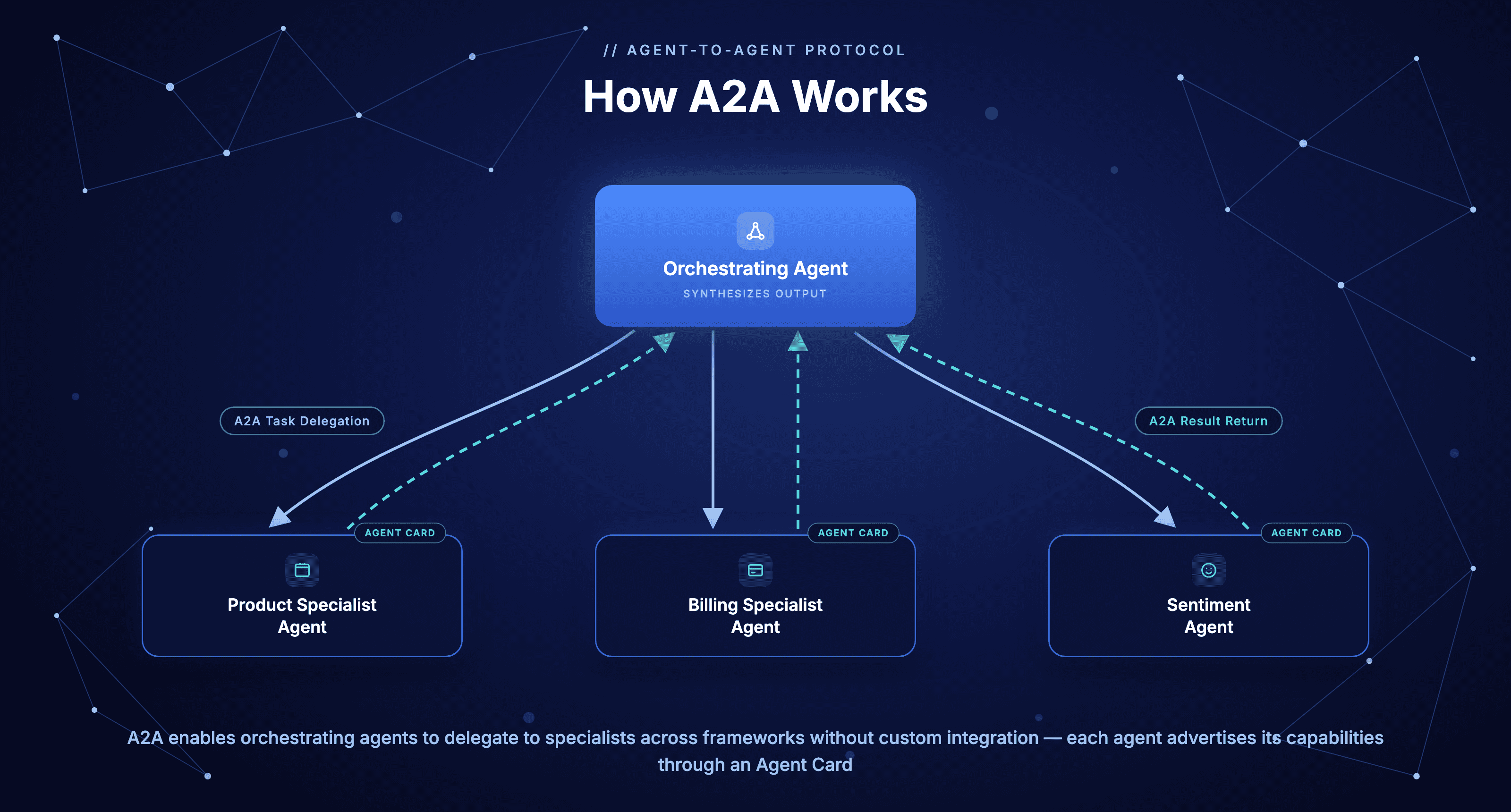
What A2A standardizes. A2A defines how agents advertise their capabilities through "Agent Cards" — structured documents that describe what the agent can do, what inputs it accepts, and what outputs it produces. It defines how tasks are delegated from one agent to another, how context and state are transferred between agents, and how results are returned to the originating agent. It also defines how agents discover each other, which is the prerequisite for dynamic multi-agent collaboration that does not require hardcoded routing.
A2A in practice. In a multi-agent customer service system, an orchestrating agent receives a user query and, using A2A, delegates to a product specialist agent, a billing specialist agent, and a sentiment analysis agent in parallel. Each specialist processes its subtask independently and returns results through A2A. The orchestrating agent synthesizes the results into a response. Each specialist was potentially built by a different team using a different framework. A2A is what makes the coordination possible without custom integration code between each pair of agents.
Where Each Protocol Applies
Understanding when to use each protocol becomes straightforward once the architectural roles are clear.
Use MCP when an agent needs to access an external tool, service, or data source — web search, a database, an API, a file system, a code interpreter, an internal enterprise system. MCP is the standardized interface that eliminates the need for custom integration code per tool. If the relationship is between an agent and a resource it uses, MCP is the relevant protocol.
Use A2A when multiple agents need to collaborate — when a coordinating agent needs to delegate to specialists, when agents need to share state across tasks, or when teams from different parts of the organization have built agents that need to work together on a shared objective. A2A is the standardized interface that eliminates the need for custom inter-agent communication code. If the relationship is between two agents coordinating on a task, A2A is the relevant protocol.
MCP | A2A | |
|---|---|---|
Developed by | Anthropic (2024) | Google (2025) |
Relationship type | Agent to Tool or Resource | Agent to Agent |
Primary purpose | Standardized tool access and invocation | Agent coordination, task delegation, state transfer |
What it standardizes | Tool description, calling convention, response format | Capability advertisement, task protocol, result return |
Solves | Integration overhead per tool per framework | Coordination overhead per agent pair per framework |
Applies when | An agent needs external capabilities | Multiple agents need to collaborate |
Complementary to | Used alongside A2A | Used alongside MCP |
Why Your Platform Needs to Understand Both
A multi-agent platform that only supports MCP can integrate tools efficiently but cannot coordinate between agents using the A2A standard. A platform that only supports A2A can coordinate agents effectively but requires custom integration work for every tool each agent needs. A platform that supports neither forces developers to implement both problems from scratch, per framework, per deployment.
The enterprise reality. Enterprise multi-agent deployments are not single-framework affairs. Different teams build different agents on different frameworks — for legitimate technical and organizational reasons. When those agents need to work together, A2A provides the coordination layer. When those agents need to access enterprise tools and services, MCP provides the integration layer. A platform managing an enterprise agent estate needs to speak both languages fluently, not just understand them conceptually.
The governance dimension. Both protocols represent critical governance points. MCP tool calls are moments when agents access data, call external services, and produce outputs — every one of which needs to be logged, governed, and auditable under GDPR, HIPAA, or SOC 2 depending on the data involved. A2A task delegations are moments when responsibility transfers between agents — which agent is accountable for what, under whose authority, with what scope. A governance architecture that operates at the application level but not at the protocol level will have structural gaps in its compliance coverage that auditors will eventually find.
Protocol evolution. MCP and A2A are both early-stage open standards that will evolve. Platforms with tight dependencies on a specific version of either will carry update costs with every revision. Platforms that implement protocol support as an abstraction layer — rather than hardcoding protocol-specific logic throughout the stack — are positioned to adapt as both standards mature. This architectural choice compounds in importance over time.

Key Takeaways
MCP and A2A solve different problems and belong at different layers of the agent stack. MCP standardizes how agents access tools, eliminating custom integration overhead per tool per framework. A2A standardizes how agents communicate with each other, enabling genuine interoperability between agents built on different frameworks by different teams. A complete multi-agent platform needs to understand both — and to apply governance at both protocol layers. Platforms that treat these as alternatives, or that support only one, are building on an incomplete foundation for the enterprise multi-agent environments that are already here.
Frequently Asked Questions
Is MCP the same as a plugin system?
Is A2A compatible with existing multi-agent frameworks like CrewAI or AutoGen?
Do I need A2A if I only have one agent?
Which protocol should I prioritize if I can only implement one?
How does enterprise governance apply differently to MCP and A2A?
Other Blogs

AI Agent Cost Attribution: How to Track and Control Multi-Agent Spend
Phinite Team · 22 July 2026 · 4 min read
AI Agent Sprawl Is Already Here — And Most Enterprises Have No Plan for It
Phinite Team · March 2026 · 8 min read

AI Agents for Sales Teams: Automating Outbound Research and Lead Qualification
Phinite Team · 22 July 2026 · 4 min read