Phinite Team · March 2026 · 8 min read
The Three Root Causes of AI Agent Failure in Production

Most AI agents that fail in production fail for the same three reasons. Teams discover this only after months of development, failed demos, or worse — silent failures in live environments. This article breaks down the three root causes that appear consistently across enterprise AI deployments: observability blind spots, governance gaps, and environmental fragmentation. Understanding these causes is the first step toward building agents that actually survive contact with the real world.
The 88 Percent Problem
Research consistently puts the production failure rate for AI agents above 88 percent. This is not a number about bad ideas or insufficient compute. Teams building AI agents today are technically sophisticated. They know how to prompt. They know their frameworks. They can build impressive demos. The failure happens somewhere between “this works in testing” and “this is running at scale in a live environment.”
The failure modes are not random. They cluster. And after mapping deployments across enterprise environments, the same three root causes appear again and again. Understanding them is not just diagnostically useful — it is the prerequisite for building any agent architecture that will last.
Root Cause One: Observability Blind Spots
The first root cause is the most pervasive and the hardest to see by definition: enterprises have no visibility into what their agents are actually doing. An agent might be making ten API calls to complete a task. It might be reasoning incorrectly about a user’s intent. It might be hallucinating data that looks correct enough to pass through. Most teams won’t know until a downstream consequence surfaces — an incorrect report, a failed workflow, a compliance flag.
Why this matters in production specifically. Development environments produce agents that feel observable. Developers watch them run. They inspect outputs. But production environments run agents continuously, across multiple tasks, without human observers. An agent that behaves well when watched often reveals different behavior at scale. Without structured logging, decision tracing, and runtime monitoring, teams are flying blind.
The architectural answer is not just logging. Logging captures what happened. Observability captures why — what inputs the agent received, what reasoning paths it took, what tools it called and in what sequence, and what outputs it produced at each step. This level of granularity is what allows teams to debug, audit, and improve agent behavior over time. It is also the foundation of every compliance requirement that enterprise environments will eventually enforce.

Root Cause Two: Governance Gaps
The second root cause emerges as organizations move from single-agent experiments to multi-agent deployments at scale. Agents operate without guardrails. They make decisions — about what data to access, what APIs to call, what actions to take — without any policy layer that enforces organizational constraints.
The compliance dimension. Enterprise environments operate under regulatory frameworks that did not anticipate AI agents. GDPR requires data minimization and purpose limitation. HIPAA requires strict controls over who — or what — accesses protected health information. SOC 2 requires audit trails that capture every significant action. Most AI orchestration frameworks provide none of this. They were designed to make agents work, not to make them compliant.
The organizational dimension. Governance is not only about regulation. It is about organizational control. When an AI agent can call any API, access any database, and take any action within its permissions, the organization loses the ability to enforce policies at the point of execution. Teams discover this when an agent does something technically correct but organizationally prohibited — accessing a dataset it wasn’t supposed to, executing a workflow outside defined business hours, or producing outputs that violated brand or legal guidelines. The governance gap is not a configuration problem. It is an architectural one. Guardrails need to be embedded at the agent execution layer, not bolted on afterward.
Root Cause Three: Environmental Fragmentation
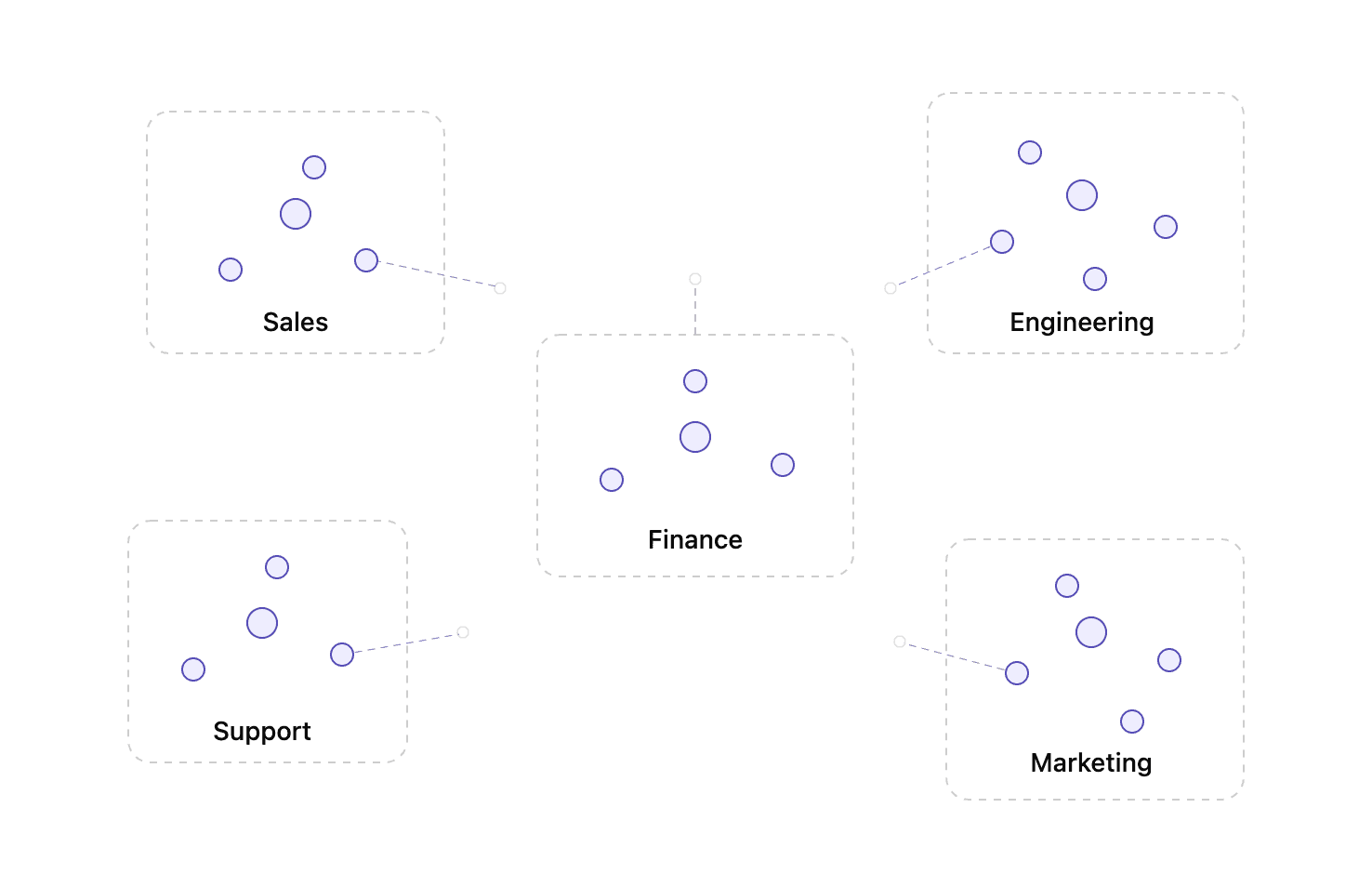
The third root cause is structural. Enterprise AI deployments are not monolithic. Different teams build different agents using different frameworks — LangChain in one team, CrewAI in another, custom AutoGen implementations in a third. These agents run in different environments, are deployed by different pipelines, and have no common interface for management or communication.
What fragmentation costs. Fragmentation means there is no unified view of the agent estate. Security cannot audit agents consistently. Operations cannot monitor them from a single pane. Compliance cannot enforce policy across all agents uniformly. And when two agents from different teams need to collaborate — which is increasingly the requirement, not the exception — they have no shared protocol for doing so.
The interoperability problem. The emergence of protocols like MCP (Model Context Protocol) and A2A (Agent-to-Agent) has started to address part of this problem. But protocols alone are not enough. What enterprise environments need is a platform layer that can speak multiple protocols, manage agents regardless of their underlying framework, and provide a consistent governance, observability, and management interface across the entire agent estate. Fragmentation is not a problem that standardized protocols solve — it is a problem that a shared infrastructure layer solves, with protocols as one of its building blocks.
What a Production-Ready Agent Architecture Looks Like
Understanding the three root causes points directly toward what a production-ready architecture requires.
Observability must be built in, not added later. Every agent action — tool calls, reasoning steps, API interactions, decision branches — needs to be captured in a structured, queryable format. This is not just for debugging. It is the audit trail that compliance teams will eventually demand, and the operational data that allows agent behavior to be improved over time.
Governance needs to operate at the execution layer. Policy enforcement cannot be a pre-deployment checklist. It needs to be embedded in the runtime environment, checking agent behavior against organizational and regulatory constraints in real time. This includes access controls, data handling policies, action restrictions, and output validation.
Interoperability requires a common agent abstraction. Instead of building governance and observability per-framework, a standardized unit of agent execution ensures that every agent — regardless of its underlying implementation — runs through the same management infrastructure. This creates a single point of management, a single source of truth for the audit trail, and a consistent interface for inter-agent communication. The teams that reach production are not necessarily the ones with the most sophisticated models. They are the ones who treated the infrastructure layer as seriously as the intelligence layer.
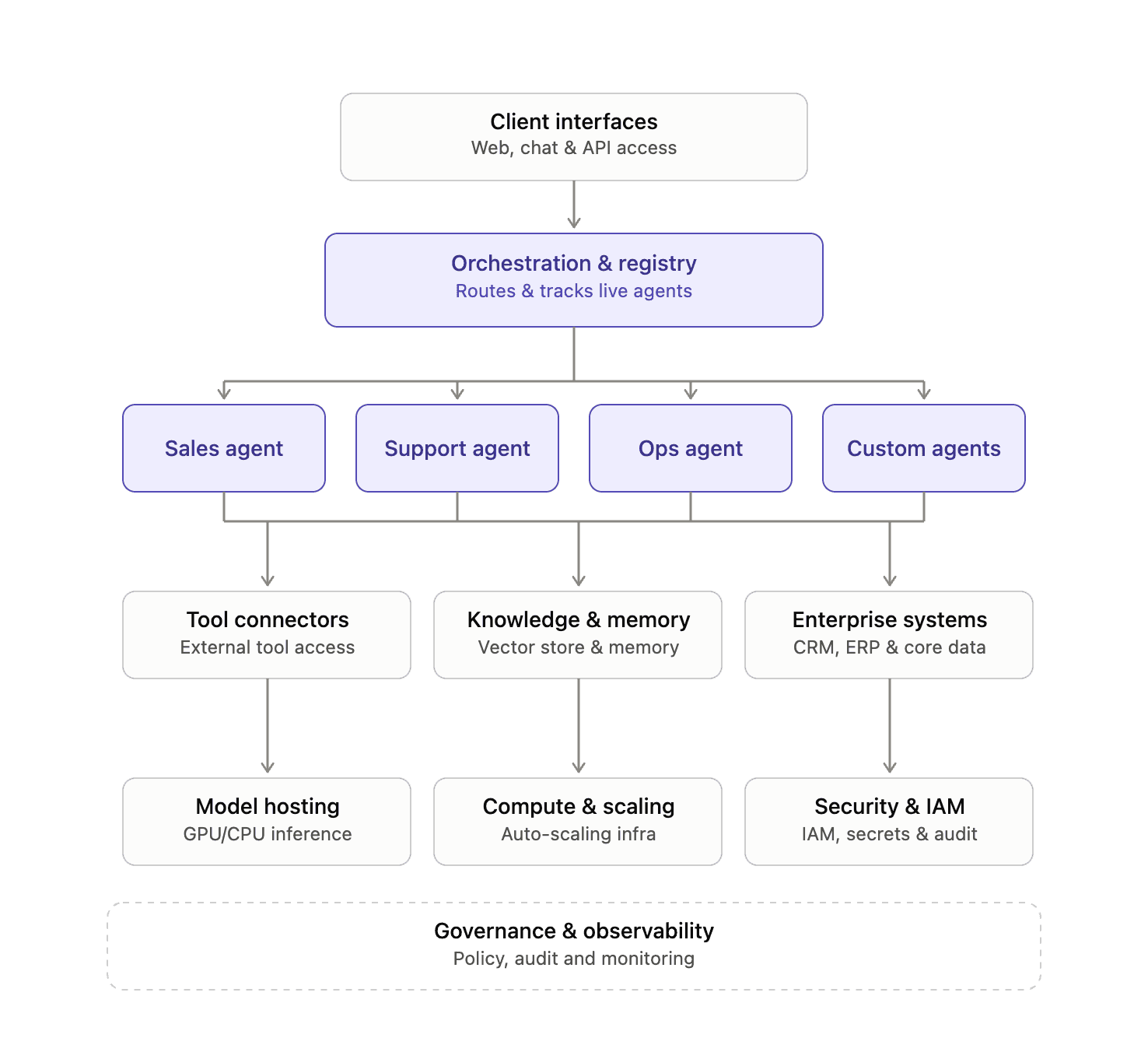
“Environmental fragmentation creates an agent estate no single team owns, no single system monitors”
Key Takeaways
Most AI agents fail in production for predictable, architectural reasons — not because the underlying models are insufficient. Observability blind spots leave teams unable to understand what their agents are doing. Governance gaps mean agents operate without the guardrails that enterprise environments require. Environmental fragmentation creates agent silos that cannot be managed or audited uniformly. Addressing all three is not optional for teams that intend to run AI agents at scale — it is the prerequisite for production viability.
Frequently Asked Questions
What is the most common reason AI agents fail in production?
How is AI agent governance different from traditional software governance?
What is the Agent Primitive concept?
Can governance be added to existing agent deployments after they are built?
How long does it take to move from pilot to production once these root causes are addressed?
Other Blogs

AI Agent Cost Attribution: How to Track and Control Multi-Agent Spend
Phinite Team · 22 July 2026 · 4 min read
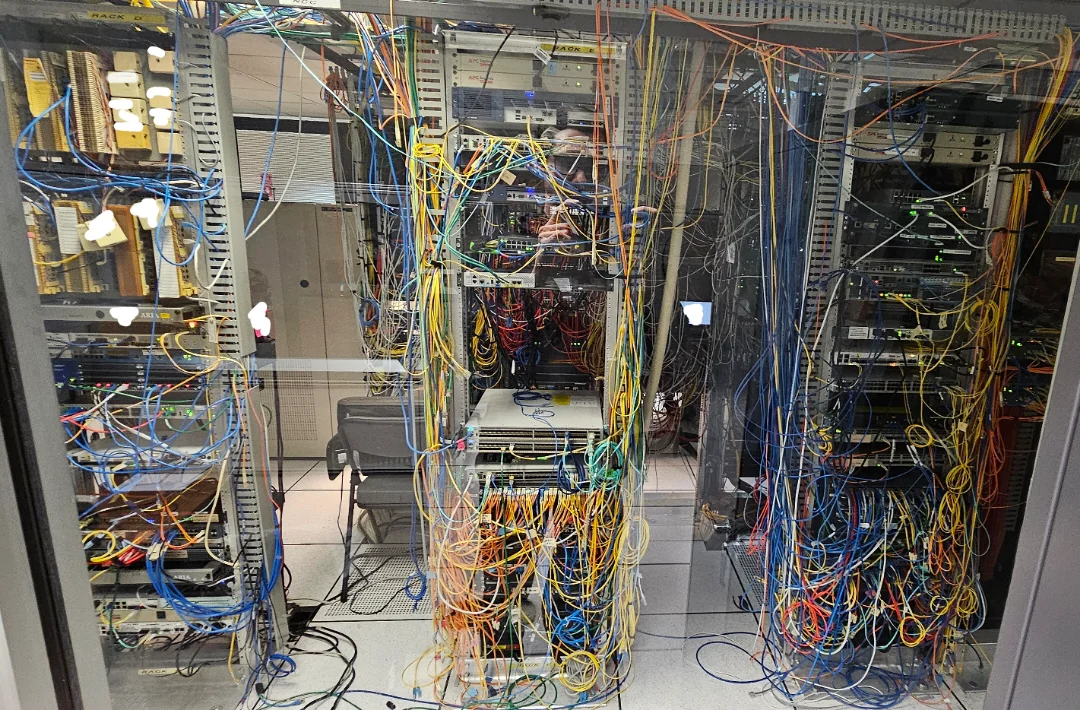
AI Agent Sprawl Is Already Here — And Most Enterprises Have No Plan for It
Phinite Team · March 2026 · 8 min read

AI Agents for Sales Teams: Automating Outbound Research and Lead Qualification
Phinite Team · 22 July 2026 · 4 min read