Best Multi-Agent AI Platforms in 2026: An Honest Comparison
Ashish Deekonda · March 2026 · 8 min read
Infrastructure
Enterprise AI
Agentic Systems
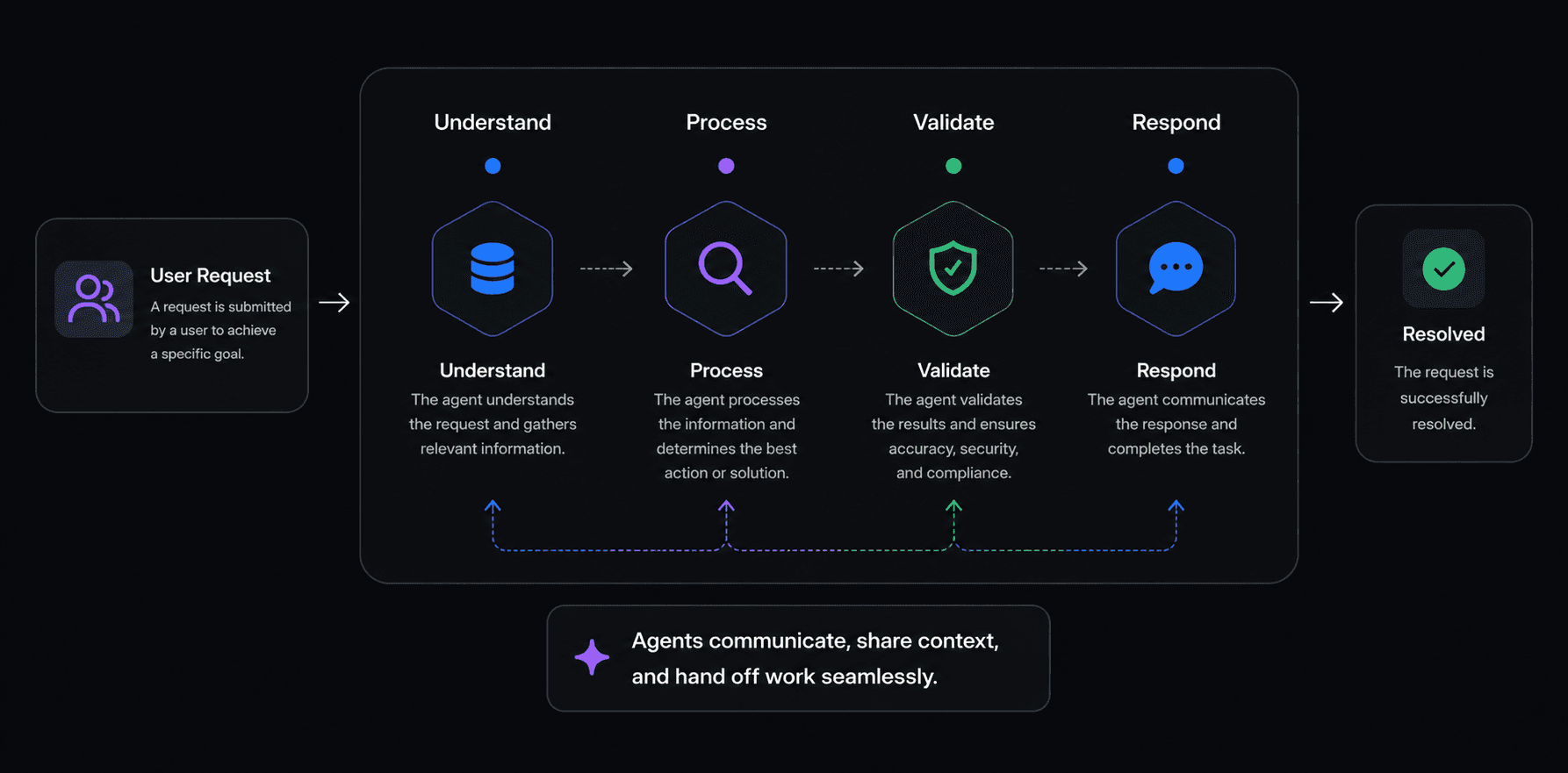
The multi-agent AI space grew up fast.
Two years ago, getting two AI agents to coordinate was a research project.
Today, there are production platforms, mature frameworks, and cloud-native services all competing for your attention.
The agentic AI market hit $7.29 billion in 2025 and is projected to reach $9.14 billion in 2026 (Fortune Business Insights).
That growth attracted a wave of tools, which makes choosing one harder than it should be.
This comparison covers the platforms and frameworks that matter right now.
We'll be honest about strengths and weaknesses, including our own.
How We Evaluated
We looked at six factors:
1. Production readiness
Can you deploy agents to real users without building significant infrastructure?
2. Design experience
How do you build and iterate on agent workflows?
3. Observability
Can you trace, debug, and monitor agents in production?
4. Enterprise features
RBAC, audit trails, compliance, security.
5. Multi-channel support
Where can your agents actually reach users?
6. Pricing clarity
Is the cost predictable and reasonable?
The Platforms
1. Phinite
What it is
A cloud-agnostic platform for building, deploying, and managing multi-agent AI systems.
Includes:
Flow Studio (visual workflow builder)
Graph Studio (graph-based design)
Phinite Aura (AI copilot)
Built-in observability
Enterprise security
Best for
Teams that want to go from design to production without building their own infrastructure.
Especially strong for multi-channel deployments:
Slack
WhatsApp
Email
Web
SMS
Pricing
Free: 1,000 sessions/month, 5 users
Professional: $249/month, 10,000 sessions
Enterprise: Custom
Strengths
Full lifecycle platform: build, deploy, monitor, secure
Native multi-channel support
Cloud-agnostic (AWS, Azure, Google Cloud, private)
Session-based pricing that scales predictably
Visual tools accessible to non-developers
Limitations
Smaller community compared to open-source alternatives
Less low-level control than framework-only tools
Newer entrant; less third-party content and tutorials
Disclosure
This article is published by Phinite.
We've tried to be straightforward about every tool, including our own limitations.
2. LangGraph (by LangChain)
What it is
An open-source, graph-based framework for building stateful multi-agent workflows.
Part of the LangChain ecosystem.
Code-first, with Python and TypeScript support.
Best for
Developers who want full control over agent orchestration logic and are comfortable building their own production infrastructure.
Pricing
Free (open-source)
LangSmith (observability) starts at ~$39/month
Strengths
Maximum flexibility for custom graph-based architectures
Open-source transparency
Strong state management with persistence and fault tolerance
Active community and extensive documentation
Compatible with OpenAI tool-calling format
Limitations
Documentation described as "fragmented" with conflicting patterns (LangWatch, 2025)
Production deployment, monitoring, and security are your responsibility
Steep learning curve for non-trivial workflows
Observability requires the separate LangSmith product
3. CrewAI
What it is
A Python framework (with optional cloud platform) for building multi-agent systems using a "crew" metaphor.
Agents are defined with:
Roles
Goals
Backstories
Offers sequential and hierarchical task execution.
Best for
Teams that want a high-level, intuitive abstraction for defining multi-agent systems and are willing to handle production infrastructure.
Pricing
Free (open-source core; 50 executions/month on cloud)
Paid from $99/month
Ultra at $120,000/year
Enterprise custom
Strengths
Intuitive "crew" mental model lowers the entry barrier
Open-source core framework
Growing enterprise features (visual editor, GitHub integration)
Active community and solid documentation
Limitations
Production tooling is thin outside Enterprise tier
Multi-channel deployment requires custom integration
Reviews note "buggy, brittle" experiences with some abstractions
Pricing jump from entry tier to Ultra ($120K/year) is steep
4. AutoGen (by Microsoft Research)
What it is
An open-source framework for building multi-agent AI applications.
Features:
AgentChat for high-level development
A Core layer for custom implementations
AutoGen Studio for no-code prototyping
Best for
Research teams, Microsoft ecosystem users, and teams that want a flexible foundation with strong academic backing.
Pricing
Free (open-source)
Azure integration for production hosting (Azure pricing applies)
Strengths
Strong research foundation (Microsoft Research)
AutoGen Studio provides a web-based UI for prototyping without code
Modular architecture with separate AgentChat, Core, and Extensions layers
.NET support in addition to Python
State-of-the-art performance on agentic benchmarks
Limitations
Production deployment is entirely self-managed
Less commercially focused than alternatives
Integration ecosystem is Microsoft/Azure-weighted
No built-in multi-channel deployment
5. OpenAI Agents SDK
What it is
OpenAI's native SDK for building multi-agent systems that run on OpenAI's models.
Provides:
Agent definitions
Handoffs between agents
Guardrails
Tracing
Best for
Teams already committed to OpenAI models that want tight integration with GPT-4, GPT-4o, and future OpenAI releases.
Pricing
Pay per API call (OpenAI model pricing applies).
No separate platform fee.
Strengths
Tight integration with the best-performing commercial LLMs
Clean, well-designed SDK
Built-in tracing and guardrails
Low overhead for OpenAI-first teams
Handoff patterns make multi-agent routing straightforward
Limitations
Locked to OpenAI models (no model flexibility)
No visual building tools
Limited to what the SDK provides; less customizable than frameworks
Production infrastructure (deployment, monitoring, security) still on you
Vendor concentration risk
6. Amazon Bedrock Agents
What it is
AWS's managed service for building and deploying AI agents.
Part of the Amazon Bedrock ecosystem with access to multiple foundation models.
Best for
Teams already on AWS that want managed agent hosting integrated with their cloud infrastructure.
Pricing
AWS usage-based pricing:
Model inference
Agent invocations
Infrastructure
Strengths
Managed infrastructure on AWS
Access to multiple foundation models (Claude, Llama, Titan, etc.)
Integration with AWS services (S3, Lambda, DynamoDB, etc.)
Enterprise-grade security via AWS IAM
Knowledge base integration for RAG workflows
Limitations
AWS lock-in
Less flexible for custom orchestration patterns
Pricing can be complex and hard to predict
Multi-channel deployment requires additional AWS services
Less community content compared to open-source tools
Comparison Table
Platform | Type | Visual Builder | Multi-channel | Observability | RBAC/Security | Cloud Flexibility | Open-source | Free Tier | Best For |
|---|---|---|---|---|---|---|---|---|---|
Phinite | Platform | Yes | Native | Built-in | Built-in | Any cloud | No | 1,000 sessions | Production teams |
LangGraph | Framework | No | DIY | LangSmith (paid) | DIY | Any (self-host) | Yes | Unlimited | Power developers |
CrewAI | Framework + Cloud | Enterprise only | DIY | Limited | Enterprise only | CrewAI or self-host | Yes | 50 executions | Quick prototypes |
AutoGen | Framework | Studio (beta) | DIY | Basic | DIY | Any (self-host) | Yes | Unlimited | Research teams |
OpenAI SDK | SDK | No | DIY | Built-in tracing | DIY | OpenAI only | Yes | Pay per call | OpenAI shops |
Bedrock Agents | Cloud service | Console only | DIY (via AWS) | CloudWatch | AWS IAM | AWS only | No | Pay per use | AWS shops |
How to Choose
Start with your constraints.
Most teams don't choose based on features alone.
The real decision depends on:
If your constraint is time to production
Choose a platform:
Phinite
Bedrock Agents
Frameworks require you to build everything around the agent logic.
If your constraint is control and flexibility
Choose a framework:
LangGraph
AutoGen
You get maximum customization at the cost of more engineering work.
If your constraint is budget
CrewAI and AutoGen have strong free tiers
LangGraph is free with paid observability
Phinite's free tier gives you 1,000 sessions with full builder access
If your constraint is cloud strategy
Phinite and self-hosted frameworks work across clouds
Bedrock Agents locks you into AWS
OpenAI SDK locks you into OpenAI models
If your constraint is team composition
Visual builders:
Phinite
AutoGen Studio
Help non-developers participate.
Code-first tools:
LangGraph
CrewAI
OpenAI SDK
Assume engineering talent.
What We're Watching
The multi-agent space is moving fast.
A few trends worth tracking:
MCP adoption
Model Context Protocol is becoming a standard for how agents connect to tools and data.
Forrester predicts 30% of enterprise app vendors will launch MCP servers by end of 2026.
Platforms that support MCP natively will have an advantage.
Observability becoming table stakes
As agents move into production, the ability to:
Trace
Debug
Audit agent behavior
Is shifting from "nice to have" to "required."
Expect every serious tool to include observability within the next year.
Consolidation
Some of these tools will merge, get acquired, or fade.
The market is too fragmented for six to eight major players to coexist long-term.
Bet on tools with:
Clear business models
Growing adoption
Frequently Asked Questions
What is the best multi-agent AI platform for enterprises?
For enterprises that need:
Production-grade security
Multi-channel deployment
Cloud flexibility
Phinite and Amazon Bedrock Agents are the most complete options.
Phinite offers cloud-agnostic deployment.
Bedrock Agents is best for AWS-committed organizations.
Which multi-agent tool is easiest to learn?
CrewAI's "crew" abstraction has the gentlest learning curve for developers.
For non-developers, Phinite's Flow Studio visual builder and AutoGen Studio offer the most accessible entry points.
Can I use multiple frameworks together?
Yes. Some teams use a framework like LangGraph for complex orchestration logic and a platform like Phinite for:
Deployment
Monitoring
Channel delivery
Hybrid approaches are common and often practical.
How much does it cost to run multi-agent AI in production?
Costs vary widely based on:
Model usage
Session volume
Infrastructure choices
At the low end, free tiers support testing and small-scale use.
Production deployments typically range from a few hundred dollars per month (Phinite Professional at $249/month) to thousands per month for high-volume enterprise workloads.
Is open-source better than a managed platform?
Neither is inherently better.
Open-source gives you:
Control
Avoids vendor lock-in
Managed platforms:
Save engineering time
Include production infrastructure
The right choice depends on your team's resources and priorities.
Other Blogs
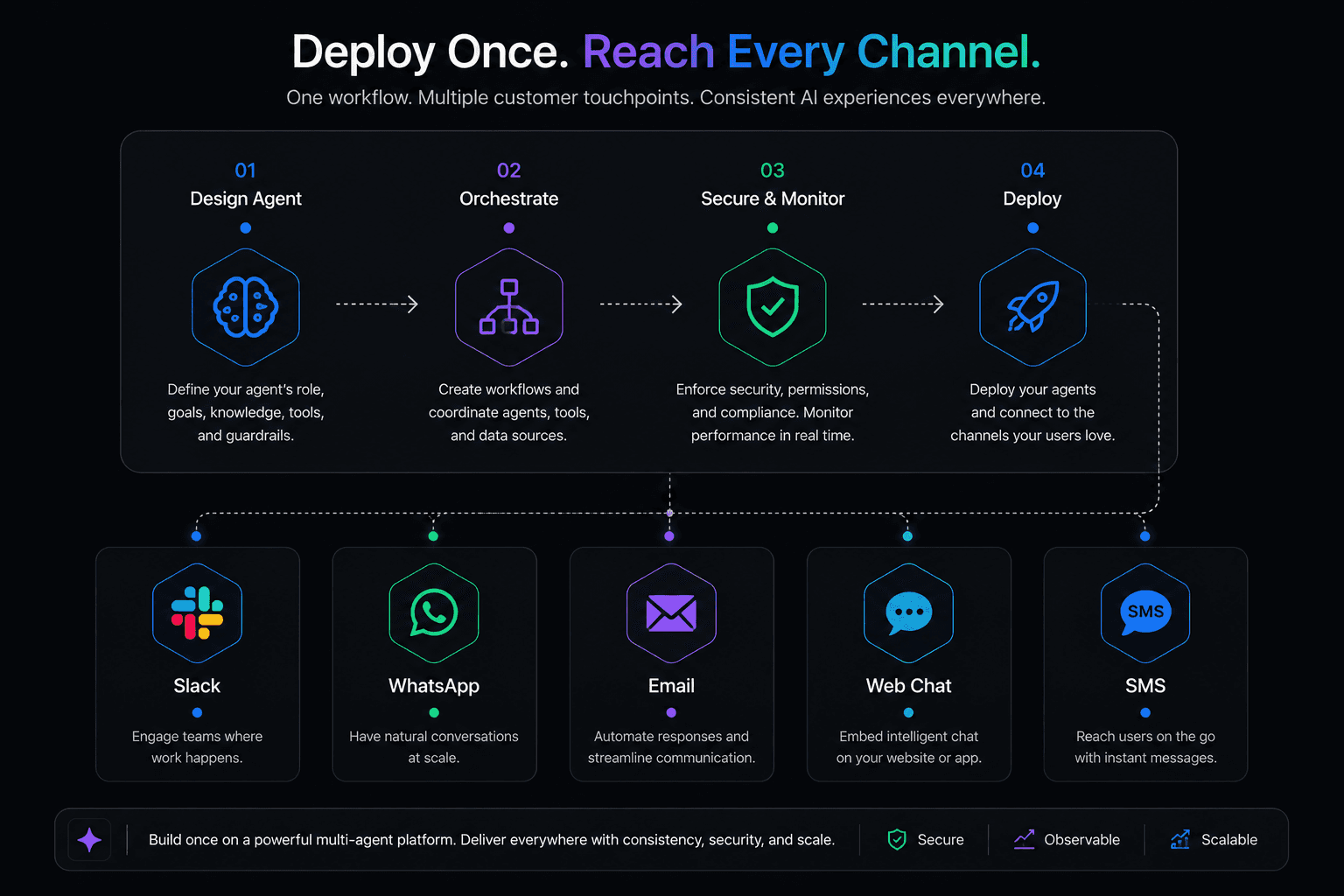
How to Deploy AI Agents Across Slack, WhatsApp, and Email
CrewAI made a name for itself by making multi-agent AI feel approachable. The idea of defining "crews" of agents with roles, goals, and backstories resonated with developers who wanted something higher-level than raw LangChain but more structured than building from scratch.
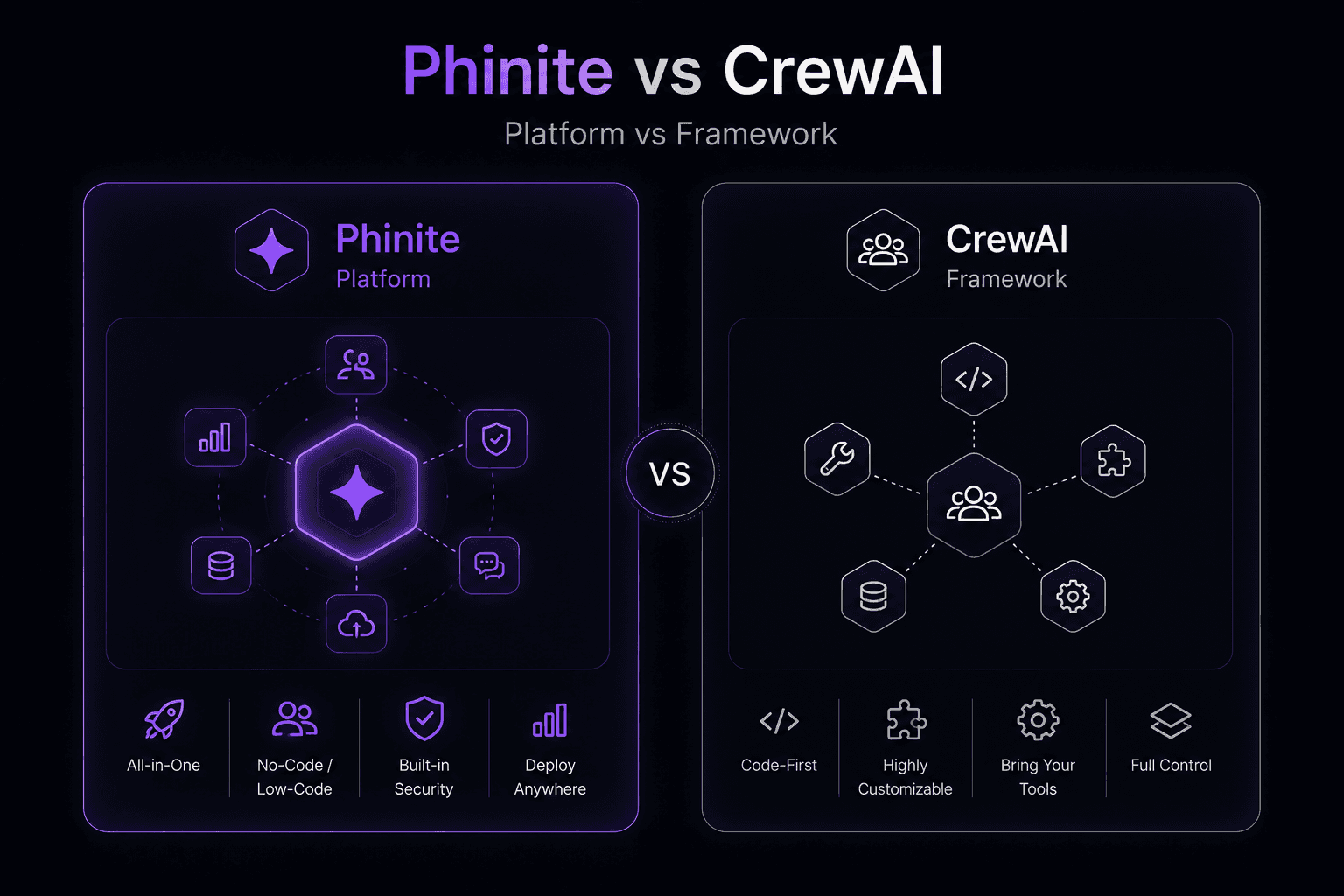
Phinite vs CrewAI: Platform vs Framework for Multi-Agent AI
CrewAI made a name for itself by making multi-agent AI feel approachable. The idea of defining "crews" of agents with roles, goals, and backstories resonated with developers who wanted something higher-level than raw LangChain but more structured than building from scratch.
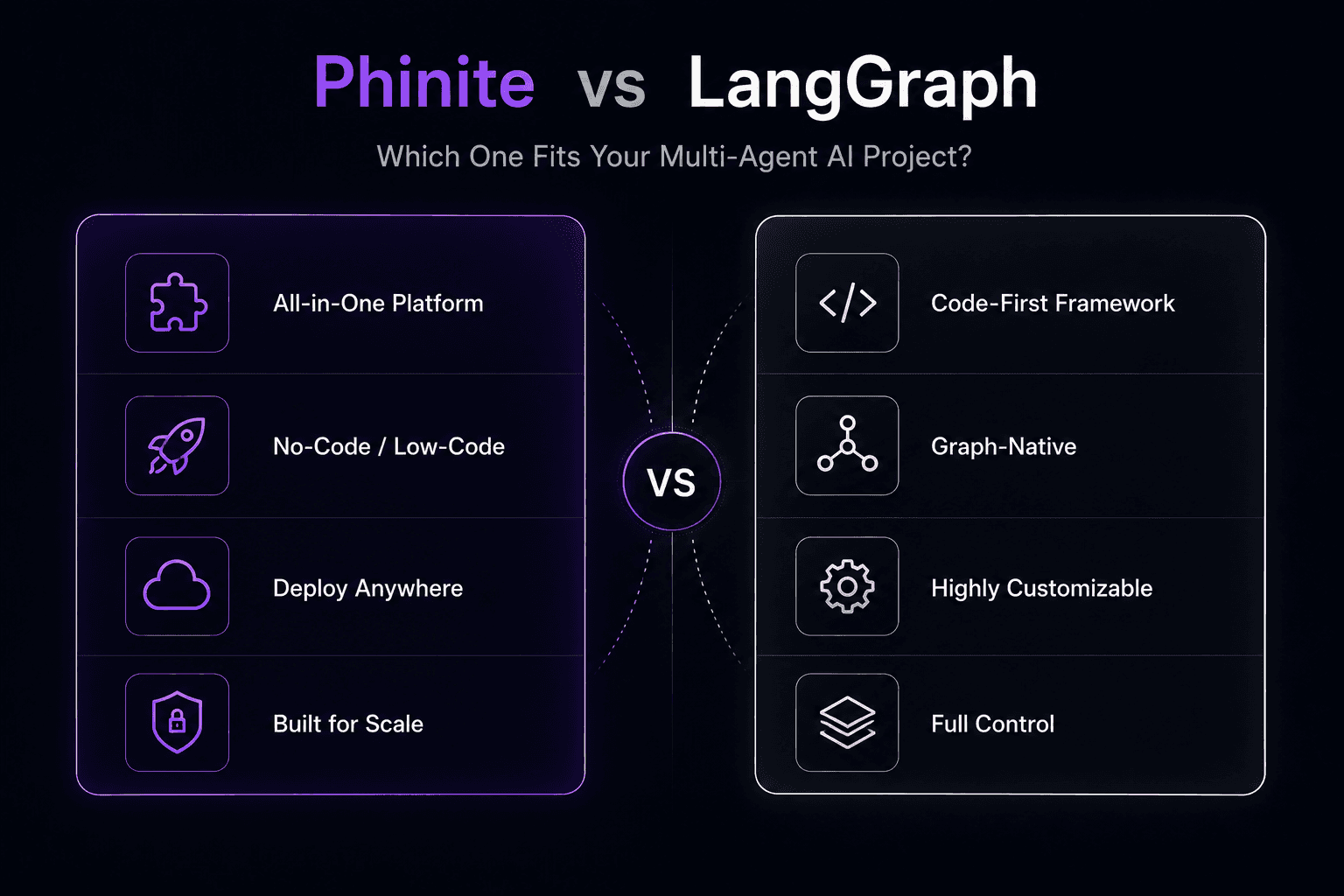
Phinite vs LangGraph: Which One Fits Your Multi-Agent AI Project?
LangGraph has become one of the most widely used tools for building multi-agent AI systems. It's open-source, well-documented, and backed by the LangChain ecosystem. If you've prototyped an agent workflow, there's a decent chance you used LangGraph to do it.